
Full-Privacy Panels
Solid tongue-and-groove panels block direct views into service yards, outdoor work areas, equipment zones, and other spaces that benefit from screening.
Serving Sioux Falls, South Dakota & surrounding areas
Open 24/7
Commercial Vinyl Fencing in Harrisburg
Commercial vinyl fencing planned around your property, installed with dependable materials, accurate layout, and a clear written scope.
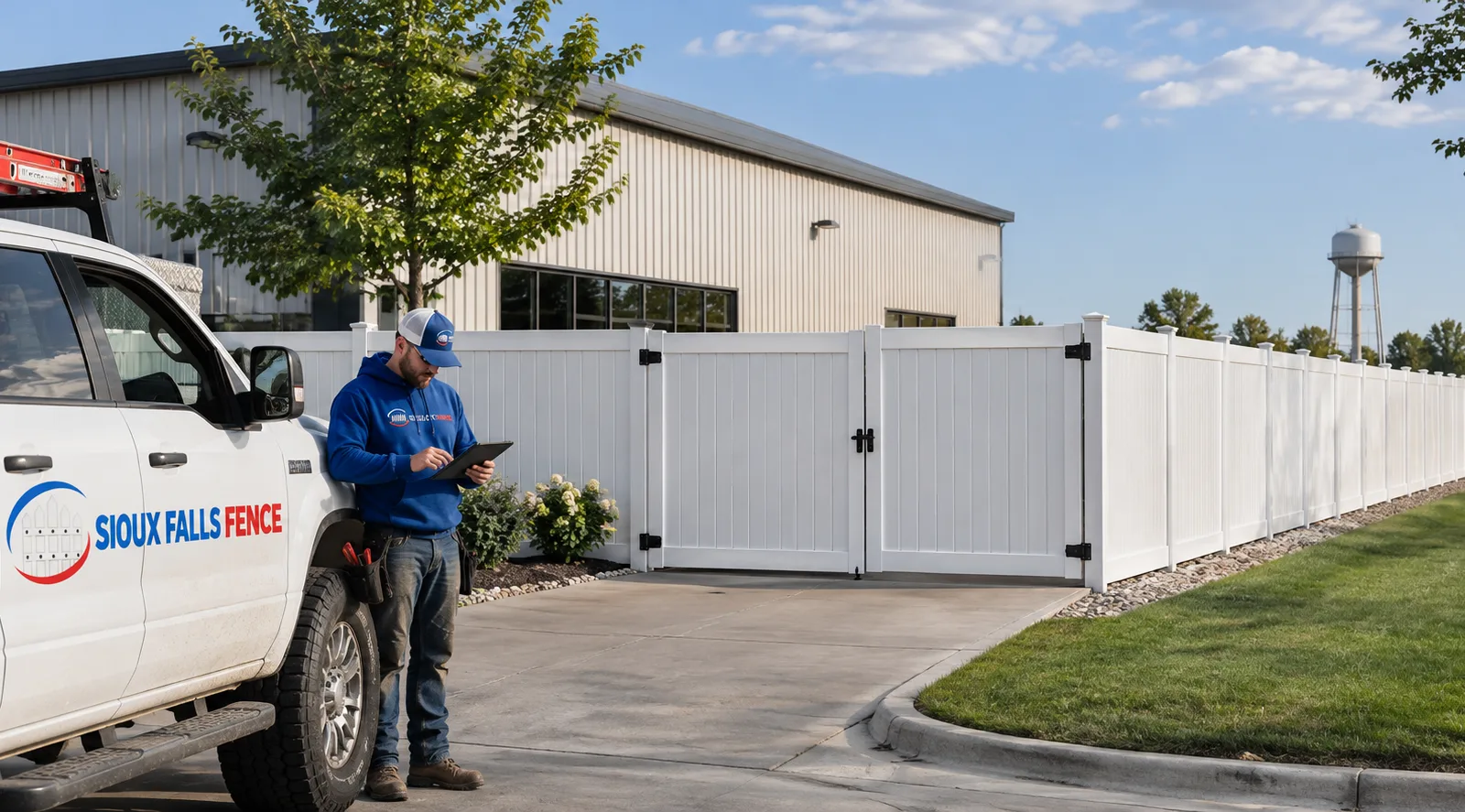
Commercial layouts account for property boundaries, daily access, gates, grade, and long straight runs.
Commercial Fence Planning
Businesses comparing Vinyl Fence Contractors Harrisburg need more than a material quote. The contractor should assess boundaries, gates, access routes, grade changes, utility conflicts, and the way employees or maintenance crews will use the enclosure. Sioux Falls Fence plans commercial installations around those practical details before posts are set.
Our fence company specialists serving Sioux Falls work with commercial property owners in nearby Harrisburg to establish a clear scope, select an appropriate vinyl system, and coordinate installation around normal property operations. That planning matters on sites near the Harrisburg industrial and commercial corridors, where vehicle access, deliveries, snow storage, and neighboring parcels can affect the layout.
Vinyl is a useful choice when a property needs privacy or separation without routine painting or staining. It does not rust, and its smooth surface is easy to wash. A complete system includes posts, rails, infill panels or pickets, caps, hardware, and gate components selected to work together. Good installation is as important as the product: post depth, footing size, spacing, alignment, and gate reinforcement all influence how the finished fence performs.
Property Assessment
A commercial fence plan starts with function. Privacy panels can screen storage, equipment, waste containers, or service areas. Picket and semi-privacy styles can define a boundary while preserving visibility. Gates need to match the expected traffic, whether that means pedestrian access, grounds equipment, or wider vehicle entry.
Harrisburg sits within the Sioux Falls metro growth area, so a fence may need to fit an occupied property, a newer commercial parcel, or a site still being developed. Before excavation, property lines should be confirmed and underground utilities located through South Dakota 811. The owner or project manager should also verify applicable City of Harrisburg requirements, easements, setbacks, and any private development standards.
South Dakota weather adds practical design considerations. Freeze and thaw cycles can move poorly supported posts, while open-area winds place pressure on solid privacy panels. Contractors should evaluate post embedment, concrete footings, panel configuration, and exposure rather than relying on one installation detail for every property. Snow removal routes also deserve attention so plowed snow is not routinely pushed against the fence.
Commercial Configurations
Solid tongue-and-groove panels block direct views into service yards, outdoor work areas, equipment zones, and other spaces that benefit from screening.
Spaced or louvered components provide separation while allowing more airflow. The exact design should account for the site's exposure and the degree of screening required.
Picket systems define property edges, landscaped areas, and pedestrian routes without creating a solid visual barrier.
Walk gates and wider openings require compatible hinges, latches, reinforced components, and enough clearance for their intended traffic.
White is common, while tan, gray, and wood-look options may suit the building exterior or development standards. Availability varies by product line.
Stepped or racked layouts can follow sloped ground. The right approach depends on the panel system, the grade, and acceptable gaps along the bottom.
Assessment to Completion
A measured process coordinates site use, layout, underground facilities, installation details, and final gate operation.
We discuss the purpose of the fence, expected gate traffic, privacy needs, access limitations, grade changes, and scheduling concerns. Existing site conditions are documented before the layout is finalized.
The proposed fence line, approximate footage, style, height, gate locations, hardware, and installation assumptions are put into a written scope. Property owners remain responsible for providing an accurate boundary survey when the line is uncertain.
Public underground facilities should be marked through South Dakota 811 before digging. Private lines, such as irrigation, lighting, or privately installed electrical service, may require separate locating. Permit and development requirements are confirmed for the specific address.
Crews establish the line and grade, excavate post holes, set and align posts, and allow footings to stabilize as required. Rails, panels, caps, gates, and hardware are then installed to the product specifications.
The completed fence is checked for alignment, secure components, gate movement, latch operation, and cleanup. The property representative can review maintenance guidance and any site-specific operating notes.
Installation Details
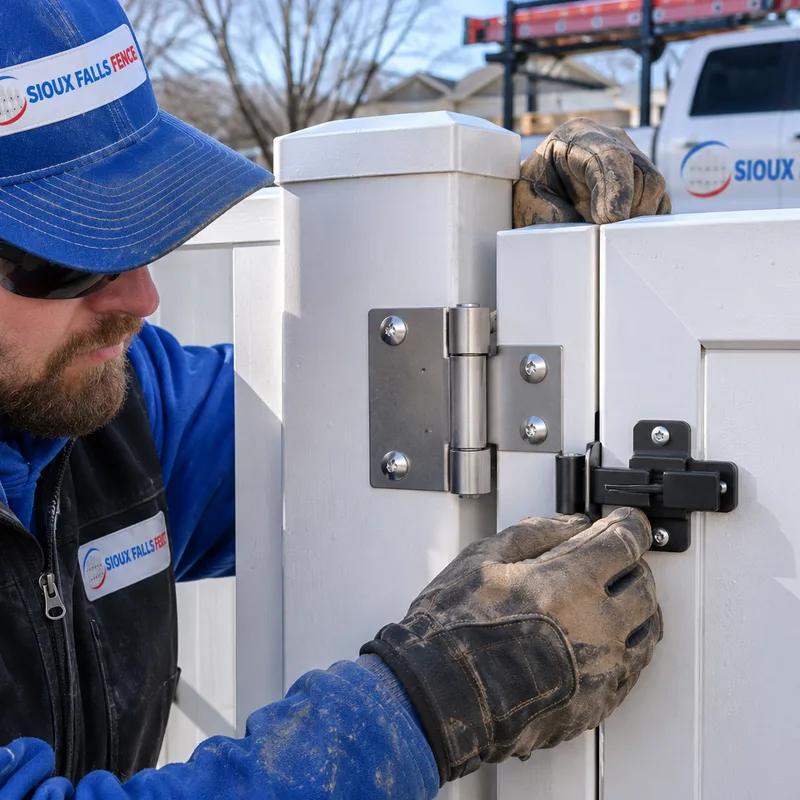
Panel quality alone cannot correct a weak layout or undersized support. Commercial gates create concentrated loads at hinge posts, so gate openings often need stronger posts, internal reinforcement, or other manufacturer-approved support. Hardware should match the gate's size and use rather than being selected only by appearance.
Straight runs require controlled post spacing. Small errors can accumulate across a long boundary and leave the final panel awkwardly cut or a gate out of position. Grade transitions must be planned before installation begins, especially when the fence meets pavement, drainage paths, retaining structures, or another fence type.
Thermal movement also matters. Vinyl expands and contracts as temperatures change, so rails and panels need the clearances specified for the system. Fasteners, brackets, and routed posts should be compatible with the selected product. Sioux Falls Fence accounts for these details in the scope instead of treating every vinyl system as interchangeable.
Contractor Comparison
Compare contractors by the completeness of their scope, not by one bottom-line number. A useful proposal identifies the fence style and height, total footage, post and rail system, gate sizes, hardware, removal work, access assumptions, and responsibility for permits or private utility locating. It should also distinguish included work from allowances or potential change orders.
Ask who will verify the layout, how uncertain property lines are handled, and what installation method is planned for exposed or high-use areas. Product and workmanship coverage should be explained separately because manufacturer warranties usually apply to material defects, while installation coverage comes from the contractor. Request the applicable terms in writing.
Commercial clients should also discuss staging. A fence project may temporarily affect loading areas, employee parking, pedestrian routes, or secured spaces. If continuous containment is required, that condition should be identified during planning. A capable contractor can sequence removals, post work, panels, and gates around reasonable access needs, subject to site conditions and concrete cure requirements.
Share the property layout, intended fence use, and gate requirements to receive a commercial scope based on the actual site.
Call for a Free EstimatePlanning and Maintenance
Commercial vinyl fencing is priced by the complete project rather than footage alone. Height, panel style, post specifications, total footage, gate width, reinforcement, demolition, grade changes, access, and private utility conflicts all affect the price. A long, open run generally has different labor demands than a short enclosure with several reinforced gates. A site review is the reliable way to establish a written cost for a Harrisburg property.
Permit and zoning requirements depend on the property, fence height, location, and current City of Harrisburg rules. Easements, corner visibility, setbacks, and private development standards may also affect placement. Requirements should be checked for the specific address before installation, and an owner should provide a survey when the legal boundary is unclear.
Public underground utilities should be marked through South Dakota 811 before excavation begins. That service may not identify private facilities such as irrigation, landscape lighting, septic components, or privately run electrical lines. The scope should state who requests public markings and who is responsible for identifying private lines.
Vinyl can work on an exposed property when the system and installation are selected for the site. Solid privacy panels receive more wind pressure than open picket designs, so post size, spacing, embedment, footings, reinforcement, and manufacturer limits require careful review. Exposure and snow placement should be discussed before a design is approved.
The schedule depends on footage, gate count, removals, terrain, material availability, utility marking, approvals, and concrete cure needs. A straightforward open run may move faster than a compact enclosure with multiple access points. Harrisburg weather and frozen or saturated ground can also affect excavation and scheduling. The project schedule should be confirmed after the site review and material selection.
Many vinyl systems can accommodate a slope through racking or stepped panels, but the correct method depends on the product and grade. Stepping can create larger gaps at the lower edge, while rackable panels have defined slope limits. The contractor should measure the grade and explain the finished appearance before materials are ordered.
Vinyl does not need routine painting or staining, but it still benefits from periodic washing and inspection. Gates, hinges, latches, caps, and panels should be checked after heavy use or severe weather. Snow piles, equipment, and stored materials should be kept from pressing against the fence, especially along plowed commercial areas.
Commercial Project Planning
Tell Sioux Falls Fence how the enclosure needs to function. We will review the site conditions, material choices, access points, and installation scope so you can make an informed decision.